
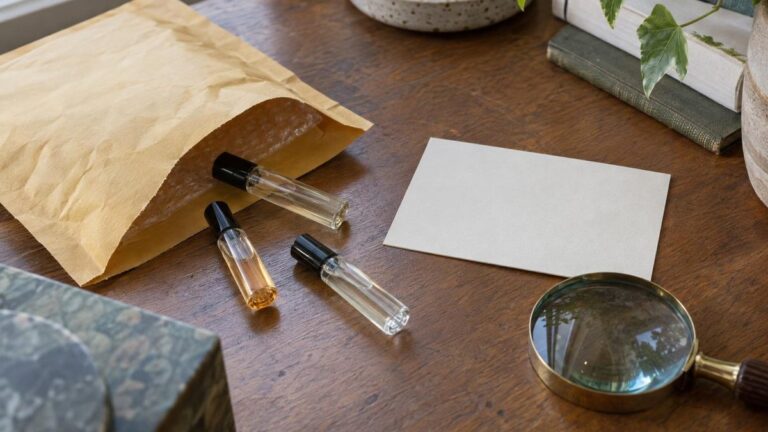
The best fragrance samples arrive in the mail from the brand itself, in a padded envelope with a vial and a card. The worst arrive the same way, from a seller who copied the packaging and filled the vial with something else. This guide covers how the real programs work, what a counter will give you, and how to tell the two envelopes apart.
The brand programs are real but irregular: a house opens a sample form for a launch, closes it when the vials run out, and opens another months later. That is why this guide teaches the pattern rather than listing offers that will be gone by the time you read them.
- How brand sample forms and mailing lists work
- What to ask for at a department store counter
- The three signs of a scam “free sample”
- Spotting a counterfeit, with U.S. Customs’ warning
Brand Sample Forms and Mailing Lists
Fragrance houses sample new launches through forms on their own websites, usually promoted by social ads: you enter a mailing address, and a vial arrives in two to six weeks. Joining the brand’s newsletter is the reliable way to hear about the next one, because the forms are rarely linked from the main menu.
- The form sits on the brand’s own domain, not on a page that collects offers from many brands.
- It asks for a name and address, sometimes an email, and nothing else. No card, no shipping fee, no survey that never ends.
- The confirmation comes from the brand’s email domain, and the package carries the brand’s return address.
- One vial per household is normal. A page promising a full bottle is not a sample program.
Counters: Ask After the Blotter
Department store and specialty counters keep vials for most scents on display. The approach that works is to try two or three on blotter strips, pick one, and ask whether a sample is available to wear for a day. Gifts with purchase from the fragrance houses are listed on each store’s offers page, such as Nordstrom’s gifts with purchase, and often include a deluxe mini above a spending threshold. The Sephora versus Ulta comparison on this site covers the two specialty chains in detail.
The Three Signs of a Scam Sample
The FTC’s guide to free trials describes the mechanism: a small shipping fee gives the seller your card, and a full-price charge follows, often monthly. For fragrance the pattern has three tells.
- A shipping fee. Real sample programs pay their own postage.
- A card number. No brand needs one to mail a vial.
- A countdown or a quantity limit on the page. Pressure is the product.
If a charge appears anyway, dispute it with your card issuer under the CFPB’s guidance and report the seller at ReportFraud.ftc.gov.
Spotting a Counterfeit
U.S. Customs and Border Protection seizes counterfeit perfume by the container. In one seizure announcement the agency warned that counterfeit perfumes can sometimes contain unknown chemicals, and that many counterfeit products are low quality and can cause injuries. Its Fake Goods, Real Dangers page explains why the problem is bigger than a lost purchase.
- Buy from the brand, an authorized retailer or a department store. A marketplace listing far below retail is the first warning.
- Check the box: blurry printing, misspellings, a missing batch code or cellophane that is loose are common on fakes.
- Compare the bottle to the brand’s photos: cap weight, glass clarity and the sprayer’s finish are hard to copy.
- Trust the sample: a vial from the brand or a counter is the reference. If the full bottle smells thin or turns sharp quickly, stop wearing it.
Paying for the Full Bottle Safely
Pay for fragrance with a credit card rather than a debit card or a transfer: the dispute rights the CFPB describes apply to card purchases, which matters if the bottle turns out fake. Buy-now-pay-later plans are explained on the CFPB’s page, including what happens when a return is involved. Keep the receipt and the box until the scent has been worn a few times. This is general information, not financial advice.
Samples by Mail at a Glance
| Source | What arrives | Red flag |
|---|---|---|
| Brand sample form | One vial, a card | Shipping fee or card number |
| Brand newsletter | Launch samples, sometimes a mini | Form hosted off the brand’s domain |
| Department store counter | A vial on request | None; just ask |
| Marketplace seller | Unknown contents | Price far below retail |
| Subscription box | A paid decant each month | Hard-to-stop renewal |
Frequently Asked Questions
How do I find brand sample forms?
Join the newsletters of the houses you like and watch their social accounts around launches. The forms are short-lived and rarely in the site menu.
Is a sample that charges shipping ever legitimate?
A few discovery sets charge a small fee that is credited toward a full bottle, and they say so clearly. A “free” sample with a shipping fee and no credit is the pattern the FTC warns about.
How can I tell a fake perfume?
Price far below retail, sloppy printing on the box, a missing batch code and a scent that fades or turns sharp within minutes. Buy from the brand or an authorized store.
What do I do if a seller keeps charging me?
Cancel in writing, then dispute the charge with your card issuer and report the seller to the FTC.
