
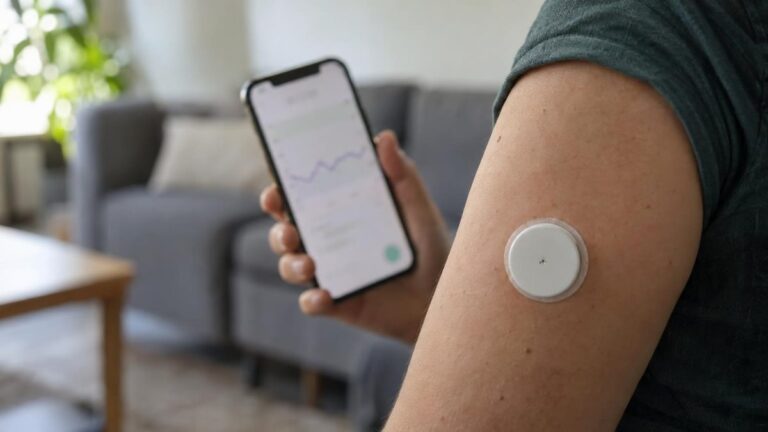
A continuous glucose monitor, or CGM, is a coin-sized sensor worn on the arm that sends a glucose reading to your phone every few minutes, day and night, without a finger prick for each check. Two systems dominate pharmacies in the United States: the Dexcom G7 and the FreeStyle Libre 3. This guide explains how the sensor works, where the two differ, and the realistic routes to getting one.
This article is general information, not medical advice. Talk to your care team before changing any treatment.
- How a sensor under the skin tracks glucose
- Dexcom G7 15 Day vs FreeStyle Libre 3 Plus, side by side
- Prescription, Medicare, insurance and over-the-counter options
- What a CGM cannot do, and when a meter is still needed
How a CGM Sensor Works
The sensor has a thin, flexible filament that sits just under the skin. It does not read blood; it reads the fluid between your cells, called interstitial fluid, and estimates glucose from it every few minutes. Because that fluid changes a little after blood does, the number on your phone runs a few minutes behind a finger-prick reading, which matters most when glucose is rising or falling fast. The NIDDK explains the three parts of a CGM: the sensor, a small transmitter and the app or receiver that displays the data.
What you get in return is a curve instead of isolated dots: you see the rise after breakfast, the dip during a walk, the overnight pattern, and alerts when glucose goes above or below the range you and your clinician set. Reports can be shared with the clinic from the app, and family members can follow readings remotely.
Dexcom G7 vs FreeStyle Libre 3: What Is Different
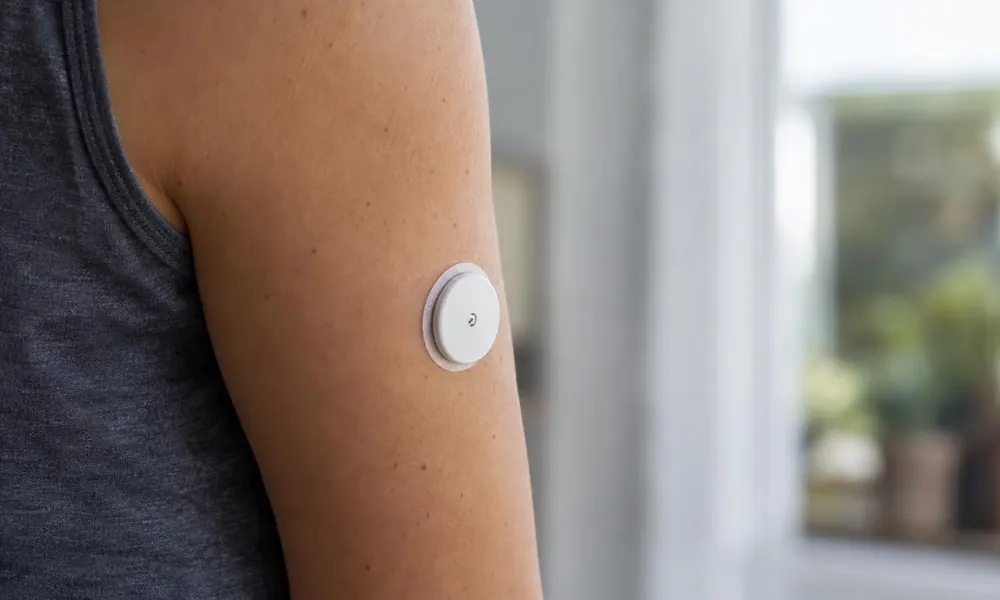
Both are small, both warm up in about an hour, both send readings to a phone with no scanning, and both are rated for about two weeks of wear in their newest versions. The Dexcom G7 15 Day was cleared by the FDA in April 2025 for adults and sends a reading every five minutes; the FreeStyle Libre 3 Plus lasts 15 days, is cleared from age 2, and sends a reading every minute. Dexcom adds a 12-hour grace period at the end of a session so you can change the sensor at a convenient time.
| Feature | Dexcom G7 15 Day | FreeStyle Libre 3 Plus |
|---|---|---|
| Wear time | Up to 15 days, plus a 12-hour grace period | Up to 15 days |
| Readings | Every 5 minutes, sent automatically | Every minute, sent automatically |
| Warm-up | About 60 minutes | About 60 minutes |
| Minimum age | 18 years (the 10-day G7 covers age 2 and up) | 2 years |
| Where it is worn | Back of the upper arm | Back of the upper arm |
| Alerts | High, low, urgent low soon, rate of change | High, low, urgent low, signal loss |
| Sharing with others | Dexcom Follow app | LibreLinkUp app |
| Sold without prescription | No (see Stelo below) | No (see Lingo below) |
Accuracy numbers published by the two companies are close, and each one quotes a study that favors its own product. For most people the deciding factors are which brand the health plan prefers, which phone and watch they own, and whether the app connects to the insulin pen or pump they use. Dexcom’s compatibility page and Abbott’s comparison page list supported phones and watches.
Both apps are free in the stores: Dexcom G7 for iPhone, Dexcom G7 for Android, FreeStyle Libre 3 for iPhone and FreeStyle Libre 3 for Android. The app alone does nothing without the sensor.
Four Ways to Get a Sensor
1. Prescription Through Your Health Plan
The standard route is a prescription from your doctor, filled at a pharmacy or by a medical supply company. Most commercial plans cover at least one of the two brands for people who use insulin, and many now cover them for type 2 diabetes managed with other medication. Ask the plan which brand is “preferred”: choosing the other one can double the copay.
2. Medicare Part B
Medicare covers a CGM and its sensors as durable medical equipment when your doctor orders it and you either use insulin or have a history of low blood sugar episodes. After the Part B deductible you pay 20 percent of the approved amount, and the supplier must be enrolled in Medicare. The rules are on the Medicare CGM coverage page; Medicare Advantage plans follow the same baseline but may add their own steps.
3. Over the Counter, No Prescription
Since 2024 two sensors can be bought online without a prescription. Stelo by Dexcom was the first, cleared by the FDA for adults who do not use insulin, which includes people managing type 2 diabetes with pills and people without diabetes who want to see how food and exercise affect them. Lingo by Abbott is sold as a wellness tool for adults not on insulin and is not intended for people with diabetes. Neither has the urgent-low alerts of the prescription systems, so they are not a substitute for someone who takes insulin. The FDA announcement describes who the first over-the-counter CGM is for.
4. Samples and Trials From the Makers
Both companies run trial programs through doctors’ offices, and Abbott offers a free trial sensor on its site for eligible patients with a prescription. A clinic that already works with one brand can often hand you a first sensor the same day.
Links above open the manufacturers’ and government sites. We are not affiliated with Dexcom or Abbott.
Paying for a CGM Without Overpaying
Sensors are a recurring cost, so the payment route matters more than the first box. If your plan has a high deductible, a health savings account or flexible spending account can pay for sensors and strips with pre-tax money, and IRS Publication 969 notes that CGMs for people diagnosed with diabetes can be treated as preventive care under a high-deductible plan, which means the plan may cover them before the deductible is met. Pharmacy discount cards and manufacturer copay programs stack on top of commercial insurance but usually not on Medicare or Medicaid. If you are shopping for a plan, the preventive care list at HealthCare.gov shows what every Marketplace plan must cover at no cost, including diabetes screening for adults at higher risk.
This section is general information, not financial advice.
What a CGM Cannot Do
- It does not replace the A1C blood test your clinic orders.
- It cannot be worn through an MRI or a CT scan; remove it first.
- Hot tubs, saunas and some adhesives shorten sensor life.
- A phone far from the sensor loses signal; readings catch up when it reconnects.
Frequently Asked Questions
Does the sensor hurt?
Most people feel a quick pinch when the applicator inserts the filament, similar to a lancet, and nothing afterward. Soreness that lasts more than a day is a reason to remove it and call the clinic.
Can I shower or swim with it?
Yes. Both sensors are water resistant for showers and swimming at shallow depth. Long baths and very hot water can loosen the adhesive.
Do I still need test strips?
Fewer, but yes. Keep a meter to confirm unusual readings, during the warm-up hour, and as a backup if the sensor fails early.
Which one is cheaper?
It depends almost entirely on your plan’s preferred brand and your deductible, not on the list price. Ask the pharmacy to run both before you commit.
