
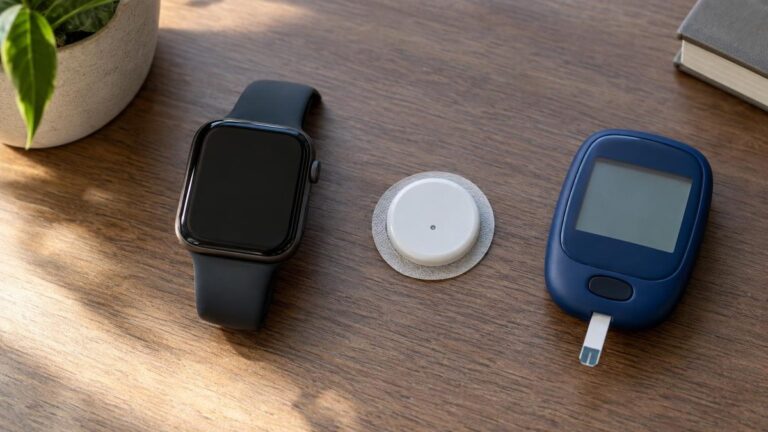
Every few months a new watch, ring or band appears online promising blood sugar readings with no needle, no sensor and no strip. None of them is real. In February 2024 the FDA told consumers not to buy or use any smartwatch or smart ring that claims to do this, and the agency has not authorized a single one since. This guide explains why, how to tell a fake from a legitimate device, and the two ways a watch can show glucose today.
This article is general information, not medical advice. Talk to your care team before changing any treatment.
- What the FDA warning actually says
- Why optical sensors cannot read glucose yet
- How to spot and report a fake device
- The two setups that put real readings on your wrist
What the FDA Said
The FDA safety communication of February 21, 2024 is short and blunt: the agency has not authorized, cleared or approved any smartwatch or smart ring intended to measure or estimate blood glucose on its own, and consumers, caregivers and clinicians should not use them. The devices are sold under dozens of brand names, often on marketplaces and social media, and their numbers are not based on any validated method.
The danger is not the wrong number itself but what people do with it. Someone who takes insulin or a medication that lowers glucose could dose based on a reading that was never real, and the FDA notes that too much of those drugs can cause dangerously low blood sugar within hours. The agency asks anyone harmed by such a device to report it through MedWatch.
Why the Technology Is Not There Yet
Watches measure heart rate and oxygen by shining light through the skin and reading what bounces back. Glucose has no such clean optical signature at the concentrations found in blood; its signal is tiny, buried under water, skin pigment, temperature and movement. Large companies have spent years and a great deal of money on the problem, and none has produced a device accurate enough to submit for approval. Until one does, any watch that shows a glucose number without a separate sensor is guessing.
How to Spot a Fake
- It claims to read glucose “non-invasively”, “painlessly” or “without a sensor”.
- It is sold on a marketplace or through social media ads, not at a pharmacy, and the listing shows no FDA clearance number.
- The brand is unknown and the same device appears under several names.
- The description mixes glucose with blood pressure, uric acid, “blood lipids” and other readings no wrist device can do.
- Reviews praise the step counter and the battery, never the accuracy of the glucose number.
If you already bought one, stop using it for any health decision, ask the seller for a refund, and if that fails, dispute the charge with your card issuer using the steps on the CFPB dispute page. Report the listing at ReportFraud.ftc.gov so it can be taken down. Return windows on marketplaces are short, so do it the week it arrives.
This section is general information, not financial advice.
What Actually Works on a Watch
1. A CGM Sensor Paired With the Watch App
The Dexcom G7 and the FreeStyle Libre 3 are the real thing: a small sensor on the arm sends readings to the phone app, and the app can show them on a compatible Apple Watch or Android watch. The watch is only a display; the sensor does the work. Our comparison of the Dexcom G7 and FreeStyle Libre 3 covers how to get one, and Dexcom’s compatibility page lists the supported phones and watches.
2. A Bluetooth Meter That Logs to the Phone
Meters such as the OneTouch Verio Reflect, the Accu-Chek Guide and the Contour Next One send each finger-prick reading to a logbook app over Bluetooth. The app, in turn, can show the latest value and trend on the watch. It is not continuous, but it is accurate, cheap and covered by most plans. The guides to OneTouch Reveal, mySugr and Glucose Buddy show how the pairing works.
Links open the FDA, CFPB and manufacturers’ sites. We are not affiliated with Apple, Samsung, Dexcom or Abbott.
Frequently Asked Questions
Does the Apple Watch have a glucose feature?
No. It shows glucose only through third-party apps connected to an FDA-authorized sensor or meter. Reports of an Apple sensor in development have not produced a product.
What about the Galaxy Watch?
The same. Samsung offers no glucose measurement; CGM apps can display readings on it.
Are smart rings any different?
No. The FDA warning covers rings as well as watches. No ring is authorized to read glucose.
Is there any non-invasive glucose device approved?
Not as of this writing. Every authorized CGM uses a filament under the skin, and every authorized meter uses a drop of blood.
